The Shamanic Journey & Addiction Recovery: Part 2
Why shamanic journeying works for addiction recovery and trauma resolution. A method, a map, and a practice.
Maybe I’m idealistic, but I see wanting to help others as part of human nature. If we’ve overcome something hard—including something as hard as addiction—it’s natural to think: What worked for me can work for you. Let me show you how it’s done.
This holds true no matter what “the thing that worked for me” is. Whether we’re talking about a 12-Step program, a path grounded in hard science, or a spiritual practice, one’s belief—backed by the proof of personal experience—anchors “the truth” of recovery in place.
On the other side of this equation, we find the person still in the grips of active, downward-spiraling addiction. Their belief is that going against that gravitational pull is overwhelming or impossible. Their experience is one of a self-perpetuating, painful cycle and the potential “failure” of relapse. Standing in their shoes, no other path feels doable or possible.
The “helper” in recovery who’s already been through it gets to then throw them a rope—tossing it down into the deep, dark well of addiction to offer the person at the bottom a way up and out. To work, this Rope of Hope must be both practical and inspirational.
The Method, the Map, the Practice
The rope that I offer clients is exactly that. It weaves together a method, a map, and a practice.
The method supplies “the how.” It tells the client: “Here’s exactly what you can do. It’s what many others, including myself, have used to do the next right thing in recovery.”
The map supplies “the way.” It tells the client: “You’re not alone. Here’s the way that many others, including myself, have taken to pull themselves up and out of the depths of that deep, dark well.”
The practice supplies “the connection.” It tells the client: “You are empowered with the necessary support from many others, including myself, who are pulling you up from the other end. We’ve achieved long-term success in sobriety, and we’ve got you.”
For me, these three essential components look like this:
- The method is the shamanic journey.
- This follows the map of the natural cycles of Nature and the laws of science, which reveal the patterned and repetitive cycle of addiction.
- Putting that into practice will change your relationships to those closest to you, as well as your relationship to spirit, Nature, yourself, and the expression of Heart you bring to work, family, society, and all other areas.
Keep It Simple: Three Principles
Because addiction often presents as mysterious and overwhelming, I like to keep things simple.
I want simple answers for myself, and I want to provide simple, practical answers to others. To do so and to explain, understand, and treat addiction, I ground my work in Three Principles:
- Principle 1: Addiction affects the whole person—mental, spiritual, emotional, and physical.
- Principle 2: Addiction is a cycle.
- Principle 3: Addiction impacts every relationship.
We can assign these principles to the method, the map, and the practice as follows.
The Method / Principle 1: Addiction affects the whole person—mental, spiritual, emotional, and physical.
By applying the method of the shamanic journey, a person can explore how addiction has affected every aspect of their person: mental, spiritual, emotional, and physical.
This is important because each aspect of the whole person has its own language and, correspondingly, its own medicine. While this is universal for everyone—regardless of race, culture, socio-economic background, or drug of choice—it’s also highly personal in how one relates to, expresses, and utilizes their relationship to these four aspects.
In other words, addiction is predictable, but you are unique.
Respecting this adage, which is one of those paradoxes where both are true at once, I apply another motto:
Make the spiritual practical.
This work cannot be entirely conceptual or based solely on faith.
To tackle something like addiction—which entails “the work” of going inward, engaging in introspection, uncovering hidden truths, and dealing with buried traumas—we need to address every aspect of the whole person and apply all four medicines.
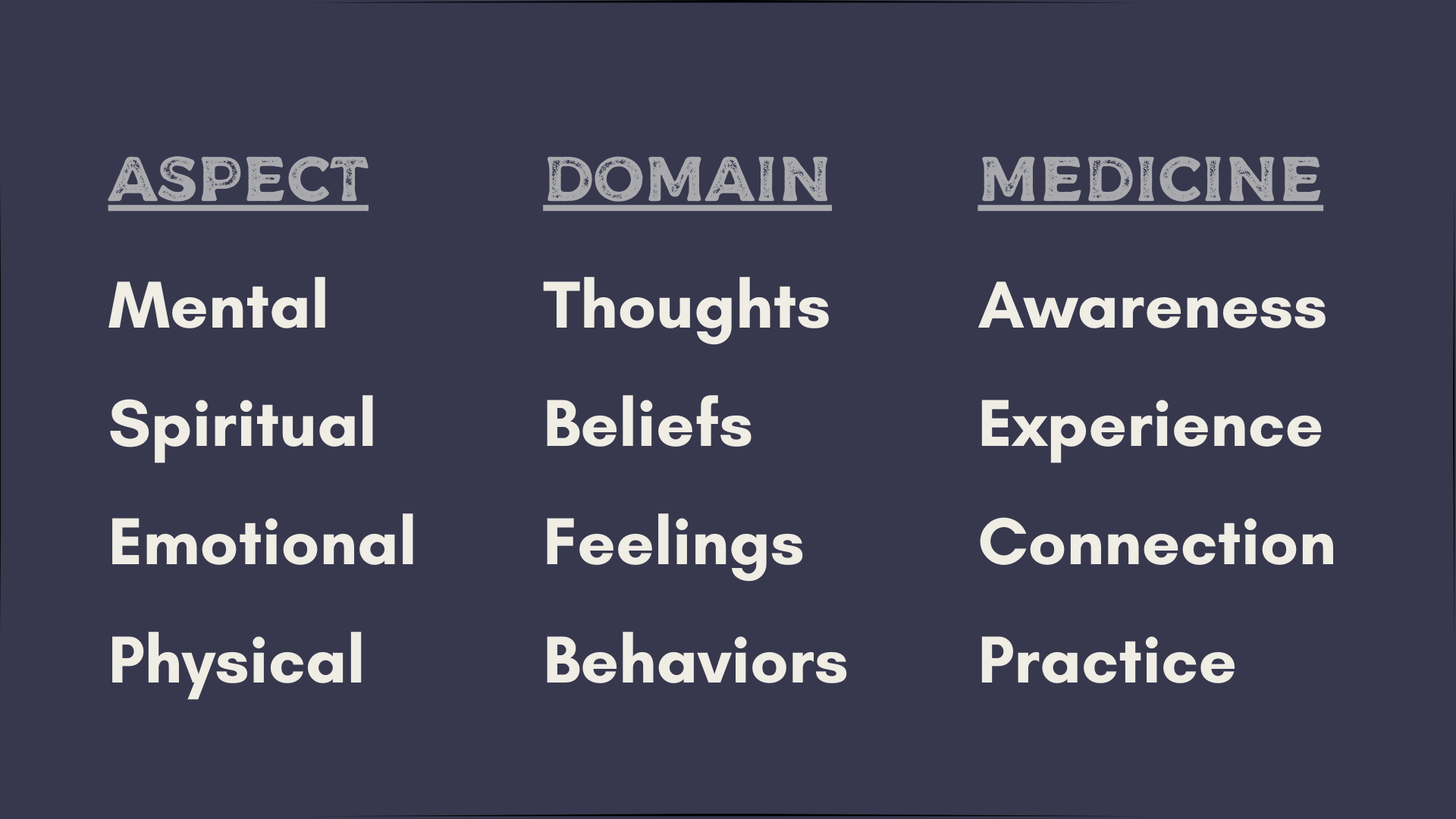
Following the chart’s downward flow from the mental to the physical, we move through the other three medicines. We need:
- New experience: Whatever we were shown, given, or told to do during the journey when in the realms of non-ordinary reality, we must bring this into our daily lives. This makes the conceptual tangible.
- New connections: By removing the “slippery people, places, and things” that perpetuate the cycle of addiction and promote relapse, we can make new connections to those who reflect and support the new awareness, as well as others who walk this path.
- New practices: The journey will reveal next steps. Implement them in everyday, ordinary reality and anchor them through daily rituals. This could be morning prayer, physical movement classes, Zoom support groups, etc. Whatever medicine was revealed to you, “chop wood, carry water.” Then do it again. And again.
A Map / Principle 2: Addiction is a cycle.
Because addiction is a cycle, it’s predictable. It follows the same universal patterns that rise and fall, are born and die, and perpetuate themselves as future repeating forms.
There really are no surprises. While this feels like—and is—a trap when one is caught in the grips of an addictive cycle, it also gives us the advantage. We know exactly:
- Where you are currently in the cycle (the present)
- How and why you got there (the past)
- What’s going to happen next (the future)
We’ve got the map. And again, it’s no mystery and there are no real surprises. As a person who’s gone around the cycle of addiction literally thousands of times, we’ll easily relate to it when presented with an objective vantage point (rather than being tossed around from inside like a sock in a washer’s spin cycle).
This map has been around for 5,000 years in the form of the Five Element cycle. We also find other iterations, as evidenced by ancient, astronomically aligned structures showing exactly where we are at exactly what time.
The beauty is that addiction is no different. We can use the map to take very specific journeys to yield very specific information. We can then apply very specific medicines at just the right time in just the right ways—leveraging our strengths and breaking the addictive cycle once and for all.
For a visual, here’s one version of the map:
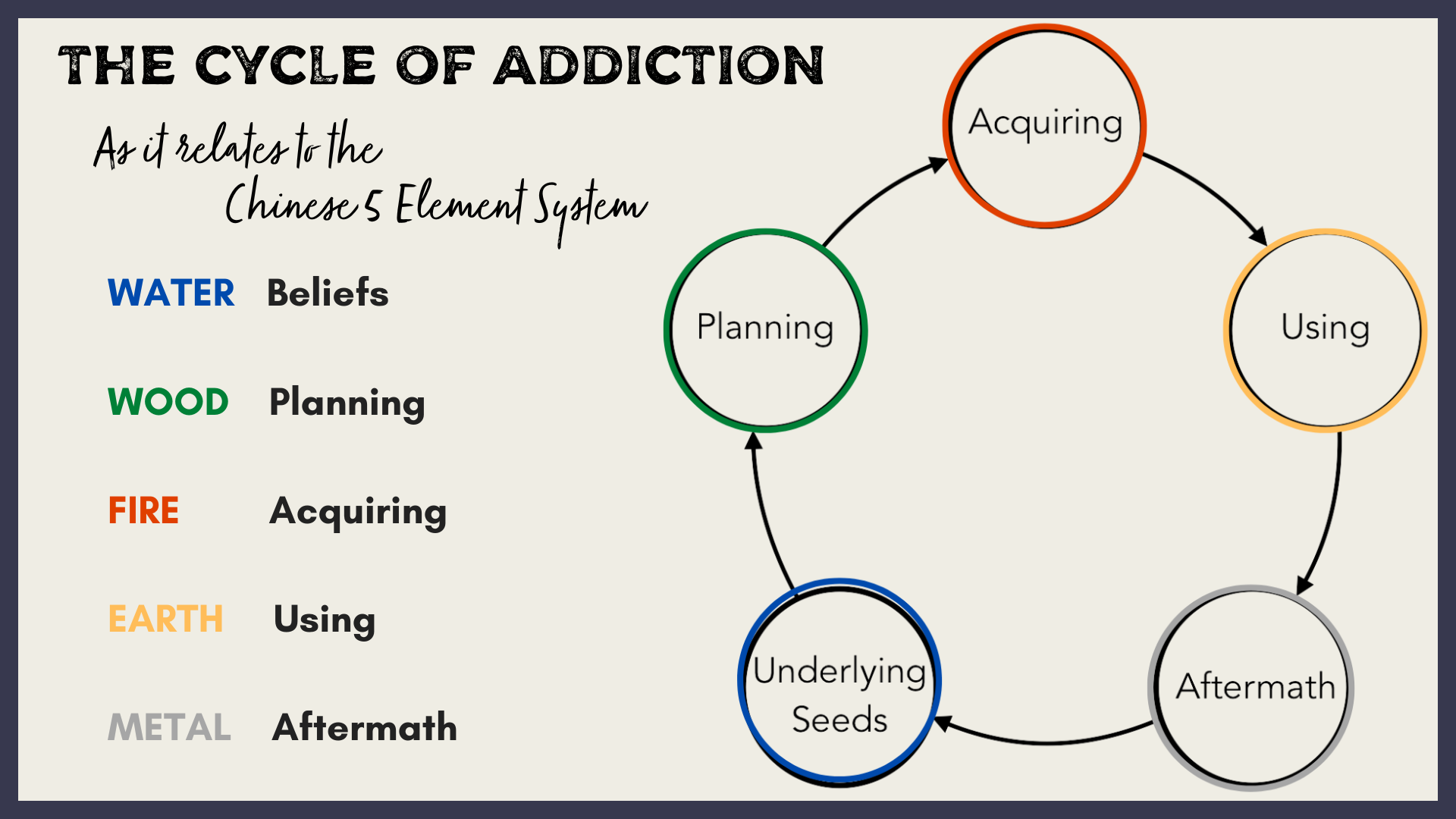
If you’d like to see how we walk step-by-step through this map and view a complete list of the 52 journeys that cover an entire year’s worth of support, head to the Free Preview here.
A Practice / Principle 3: Addiction impacts every relationship.
In recovery, we spend lots of time and energy examining the relationships we have with our family of origin and our closest partners, friends, and loved ones. This is important, needed, and can be supported through the shamanic journey.
And yet, focusing on interpersonal relationships alone is too narrow a path. For long-term success and sustainable recovery, we need to widen the lens to include our other relationships.
Because our sense of self—or our belief and adherence to our current identity—gets so damaged and warped in addiction, this changes how we interact with everything.
It follows that we need to address everything closest to us—not only our closest personal relationships. For instance:
- Where do I find meaning and purpose?
- How do I apply my true gifts?
- How can I get quiet and listen to my own rhythms and how they interface with Nature?
- What’s my relationship to food?
- What’s my relationship to my body and movement?
- What’s my relationship to sexuality?
- What’s my relationship to creativity?
- What’s my expression of everything above and everything else that I’m in relationship with?
These questions don’t have one-and-done answers. Even though we may receive the mental awareness, acquire spiritual experience, and connect with nourishing and supportive others during a shamanic journey, we still need to “do the work” and do it day in, day out.
This is a practice and requires putting one foot in front of the other and doing the next right thing as shown, shared, and given to us by spirit. And, we need to do it despite “not feeling like it” (or any other excuse).
With great power comes great responsibility.
We know what to do, we know the way forward, and we have the ability and support to do it. We have the method, the map, and the practice.
Now you.
Have questions or thoughts? Wondering where and how to get started?
Join me for a conversation in the comments or email me directly at: Randy@AlchemistRecovery.com.
If you’d like to go on a Medicine Drum Journey or do a Shamanic wRites exercise, you’ll find these Step-by-Step Guides on the Homepage. See you inside.
With All Good Medicine,
Randal