Talisman vs Symbol: Which is a More Effective Tool for Addiction Recovery?
Part 1: The Power to Change is in the Pain
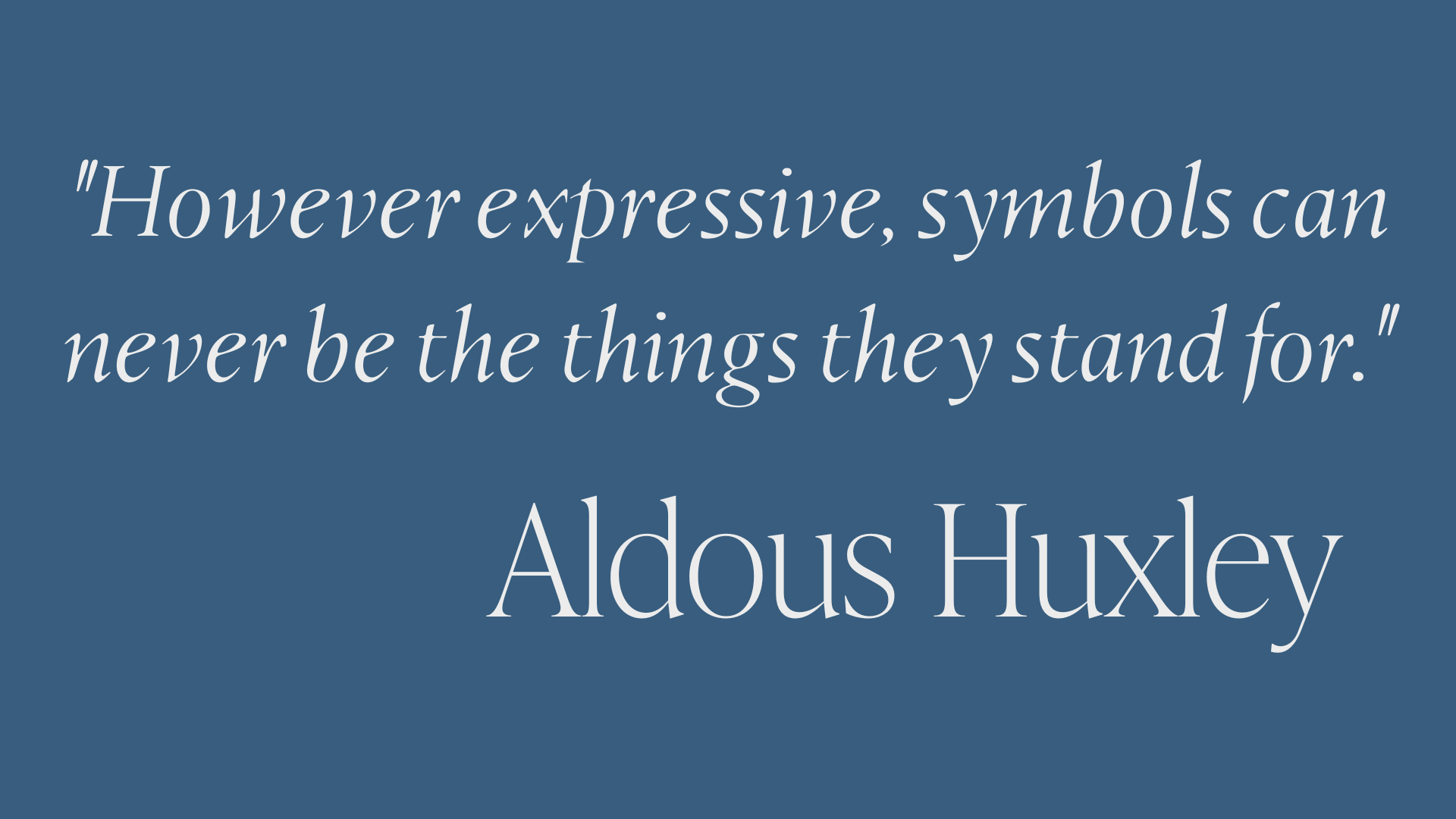
I love this quote because it speaks directly to one of the main issues of addiction: separation. Let me show you what I mean.
The Basics
If a symbol is not the thing it stands for, it therefore is separate from that thing. It, by itself, is a symbol and the thing it stands for is “the thing.” No matter how expressive this symbol is, we are still speaking about two different items; one is the symbol over here and then there’s the the thing it stands for over there. Distinct, clear and separate.
This concept of division and separation is fundamental in, and foundational for logic, science and medicine. We can’t have clarity if we do not have polarity. Separation is imperative.
This is also true when looking at some of the old stories of spirituality, which hold the psychology of separation at their core. A perfect example of this is provided by the book of Genesis, in which right from the get-go man was cast out of the Garden of Eden and separated from God. So according to this story, and this theory, and this psychology, God is over there up in heaven, and we’re over here, down on earth - separated.
Separation keeps things simple, neat and easier to understand.
This is all great news for the mind, which plays by these rules but what about for other aspects of the human condition and in particular, matters of the heart?
How does the idea of separation land with the feelings that reside here? And specifically ones like belonging, love and home?
Quite simply, separation can be the obstacle and opposing force to the feelings of belonging, love and home
So, which is better for my recovery?
I like to answer this question with, “Yes,” which of course puzzles some askers but also answers the others who understand that we need to somehow open the door to the possibilities of both and ask the questions…
What if the rational mind’s either/or need for the clarity of separation and the heart’s longing for connection and oneness are both equally true?
And both equally true at the same time?
Life is full of such paradoxes and the field of addiction recovery reveals more and more of them to me all the time.
The Symbol
The symbol uses the path of separation, so it speaks to the mind and helps us through all kinds of thinking and cognitive methods of logic.
We can find examples of this kind work everywhere because symbolism is one of the foundations of modern psychology. There is an abundant amount approaches and experienced practitioners available and with a little digging, you’ll find ones that fit your style.
So, while the symbol provides a wonderfully rich and vast amount of material to work with, I prefer to focus on the other path. In today’s world, it is definitely the path less traveled but I love it because it deals directly with the longing of the heart. Let’s dive into the soulfully poetic, rewarding, inspiring and power-full work of the talisman and explore how this helps with the heart’s longing for connection and unity.
The Talisman
From the heart’s view of our situation, the symbol takes on another life. One in which it is no longer separate from the thing it stands for but rather somehow carries “the thing itself” within it. It is, inherently and authentically, the actual thing.
This is a very different psychological perspective. The heart is the perceiver, not the mind, so it’s more about the feeling and not the thinking. It’s more about the experience and not the viewpoint. It’s more about subjective participation and not objective analysis.
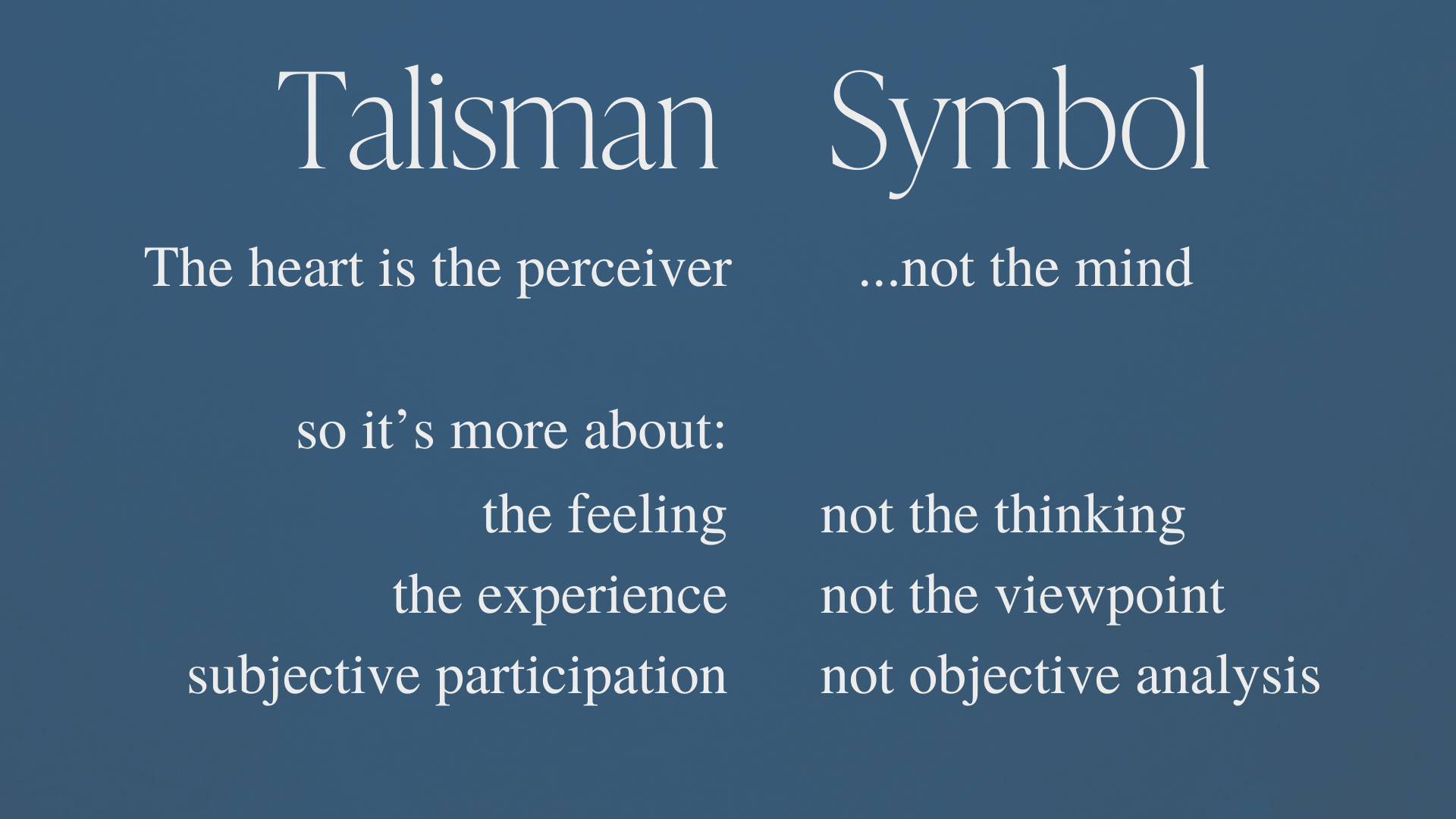
Standing here in this place of the heart, our symbol is no longer a symbol. It has been transformed into something else. One term for this is a talisman.
A talisman is not a symbol. This is because a talisman is the thing. It carries this oneness, this natural connection, inherent within it.
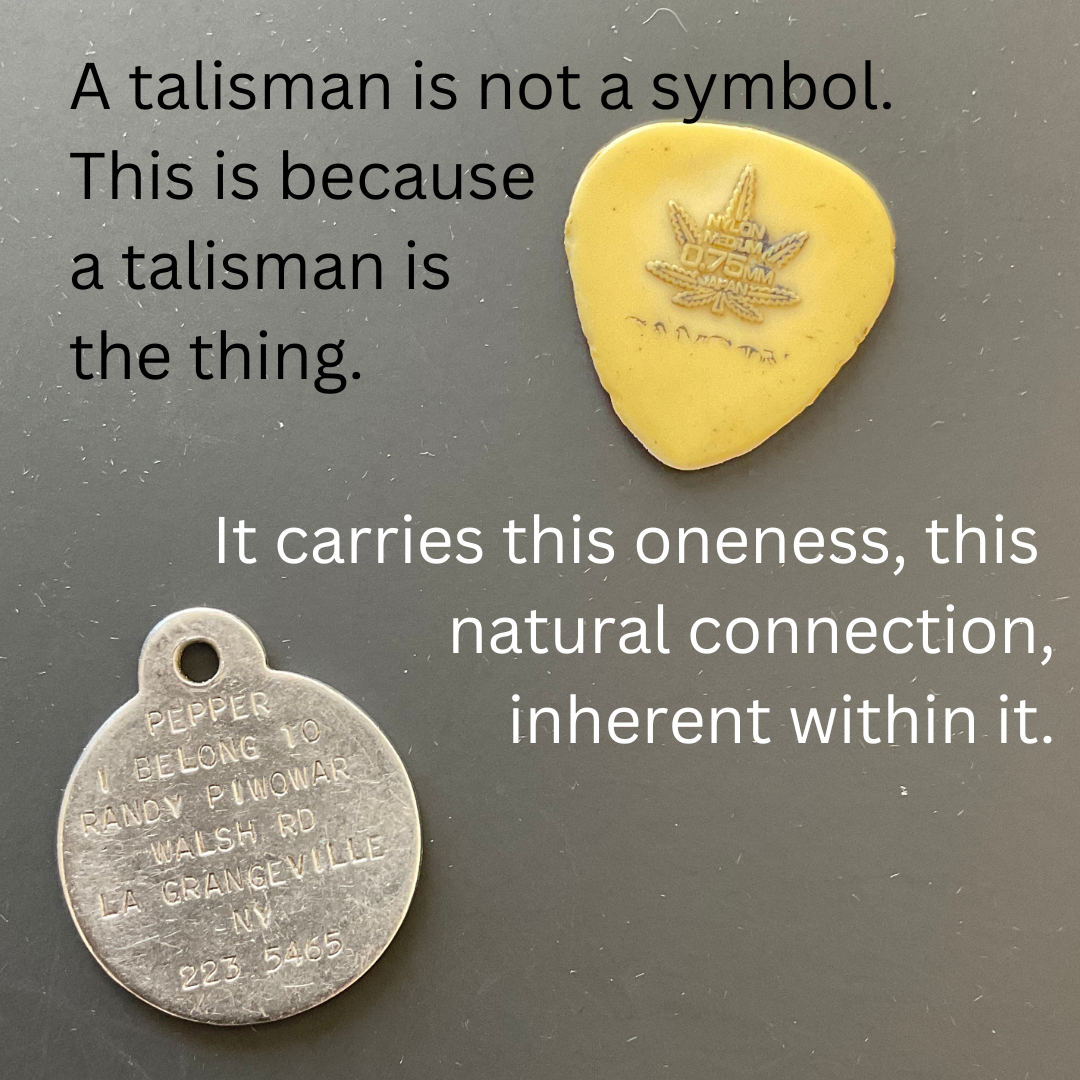
Here’s a couple of mine: a 1989 guitar pick and my Black Lab’s dog tag from about 1974
How can we make this idea work for us in recovery?
In The Sober Shaman's Path of Recovery, I love to introduce this shift in perspective because it provides us a completely different way of viewing our situation, which then provides us a completely different set of tools and the talisman is one power-full one. Here are some examples of how we’ve used talismans in the work.
Examples of a Talisman
We can separate our talismans into two types. One carries the power of past painful experiences and the other contains the power of future positive possibilities. Here, in Part 1 of this two-part series, let’s go into the pain of the past.
Talismans can carry the power of the experiences from past pain. When connecting with that, we also connect with the seeds of possibility in this present moment, which carry the potential and reminders to revisit this exact kind of pain in the future. And we know the fastest track to manifesting this kind of pain is to engage in active addiction.
We are active participants in the present moment when using a talisman. In this case, they contain the pain of the past, the seeds of the potential future, and here we are in this present moment feeling all of that and making the choice from this place of full awareness.
Here’s a few that my clients and I have used to accomplish exactly this:
Example 1: Scheming Joe
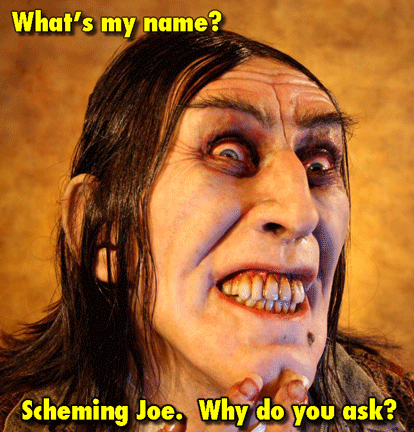
This first one is the voice of his addiction, “Scheming Joe,” who, like an addiction, will predictably and consistently offer the advice to:
- Lie
- Steal
- Cheat
- Manipulate
And he’ll do this to everyone he knows to get what he needs.
This pic puts a face to the Voice, and by putting Scheming Joe in laminated form, he’s easily carried around as a tactile reminder.
This talisman reminds my client that Scheming Joe is real. That Voice is not a symbol, it’s really there. It’s making suggestions and talking inside his noggin’…and he’s as creepy as he looks. So, when this client lets Scheming Joe’s words come out of his mouth, he now adds this dimension of visualizing that this is what “he” looks like. He’s no longer my client, he’s Scheming Joe.
This also introduces the magic and medicine of humor, because this picture is not only downright creepy but it also empowers my client to laugh at just how comical, in his predictable way, Scheming Joe actually is. He’s a bit of a joke; and when the client uses the talisman to re-connect with this, he’s able to laugh at it, as well as Scheming Joe’s suggestions when they arise.
Example 2: The Gamble
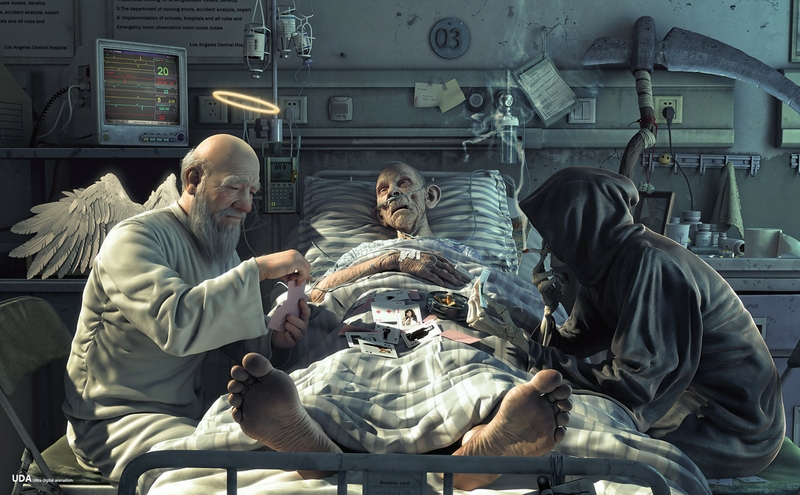
This second example of a talisman is also a picture we laminated. The client uses it to reconnect with his second incident of overdosing. It was a very different experience than his first because this time, he was left extremely shaken. And although he’s a young man, this picture’s elderly subject portrays exactly how he feels like he looked lying in that state. It also captures the reality of what moved him so deeply, as he feels “he really met these two” hovering about his hospital bed. This was his experience, with Death and an Angel, just waiting for him. This talisman re-connects him with this power and the knowledge of how high the stakes are, and how much of a gamble it is, if he shoots up again.
Example 3: The Cancer Stick

This last one “The Cancer Stick” is easy to work with, as it provides a visual that really sticks. Every time my client picks up another cigarette, she knows this is what it is. It does not represent a “Cancer Stick” it is a Cancer stick.
And in that moment, if she does continue onto the action of smoking, she is then also hit with of all of the immediate physical ramifications, like the dryness in the throat, the coughing, the shortness of breath, etc….which is anchored in as felt Cancer Stick experience.
I’ve suggested she put this laminated picture inside of the of the pack of cigarettes while she carries it around in its usual place. So whether it’s pocket or purse, when the reflexive urge is acted upon and she reaches for the cigarette, she’s met with the talisman. It is literally a guard at the door, a Guardian at the Threshold, and is protecting her against the harm to be inflicted by her own hand.
I love these pics, which as I said were laminated, turned into talismans and carried around as actual is-nesses.
Some others that I’ve used with clients have been:
- The hospital wrist band from the…operation, OD, accident, etc.
- The mug shot
- The closeup of that one line from the pile of documents: “The dissolution of marriage”
- The obituary / news story
- Piece of the totaled car that you somehow survived
We use the passage of time as a natural defense to forget the consequences or dismiss the impact of those incidents. The talisman carries the power to re-member and re-connect us to the reality that those experiences are still alive and active within us. Acknowledging this, we can use the talismans to help us feel this power and then, direct it towards healing and doing the next right thing.
Talismans vs Symbols is continued in Part 2: The Power in the Possibilities where we explore the power of the positive. These talismans are the seeds we hold in our hands that invite our participation to plant them, here and now, in the present moment. Check it out and find out how we do just that!
With Blessings,
Randal