What Spirits Are You Feeding?
How to bring ritual into recovery.
When I was seven, preparing to receive the Catholic sacrament of First Communion at St. Brigid Elementary, it sounded like a pretty big deal.
The nuns put it right up there with Christmas. I was told I’d “become as one with God.” I readied myself for “transubstantiation.”
Along with being the biggest word I’d ever heard, it sounded awesome. I couldn’t wait to take my place in this mystical, miraculous ritual whereby the priest would transform a wafer of bread into the body of Christ.
Then, after all that preparation and anticipation, the day arrived. I played my part. I received the wafer on my tongue. And…
Bupkis. Nothing. Nada. No bells, no whistles, no firecrackers, and certainly no at-one-ness with any God I could see. Just my first religious ripoff.
My disappointment that day left a scar, yes. But more than that, it left a longing for true communion. The one I’d somehow missed.
Years later, still searching for what was missing and still trying to quiet limiting beliefs and heal old wounds, I found a stand-in. I found communion in the form of addiction.
Problem, of course, is that this communion was not with God nor with any other compassionate spirit. In addiction, I ended up with the kind of spirit that destroys us. The kind that consumes and extinguishes through a painful, predictable cycle.
Ritual & Communion
Given my Catholic beginnings, I understand well that the word “communion” is loaded. That’s exactly why I use it with clients when exploring and opening conversations about addiction.
Because communion (even if you’re not Catholic) implies something mystical and spiritual. It also suggests ritual. And ritual features prominently in addiction—whatever your drug of choice.
Specifically, the rituals performed before partaking in a drug of choice are patterned and powerful. They are preparation for communion—not only with the physical substance we’re addicted to, but also the anything-but-benevolent spirits along for the ride.
Now, these rituals may seem like going through the practical motions or steps involved in preparing to consume a drug of choice. But it’s more than that.
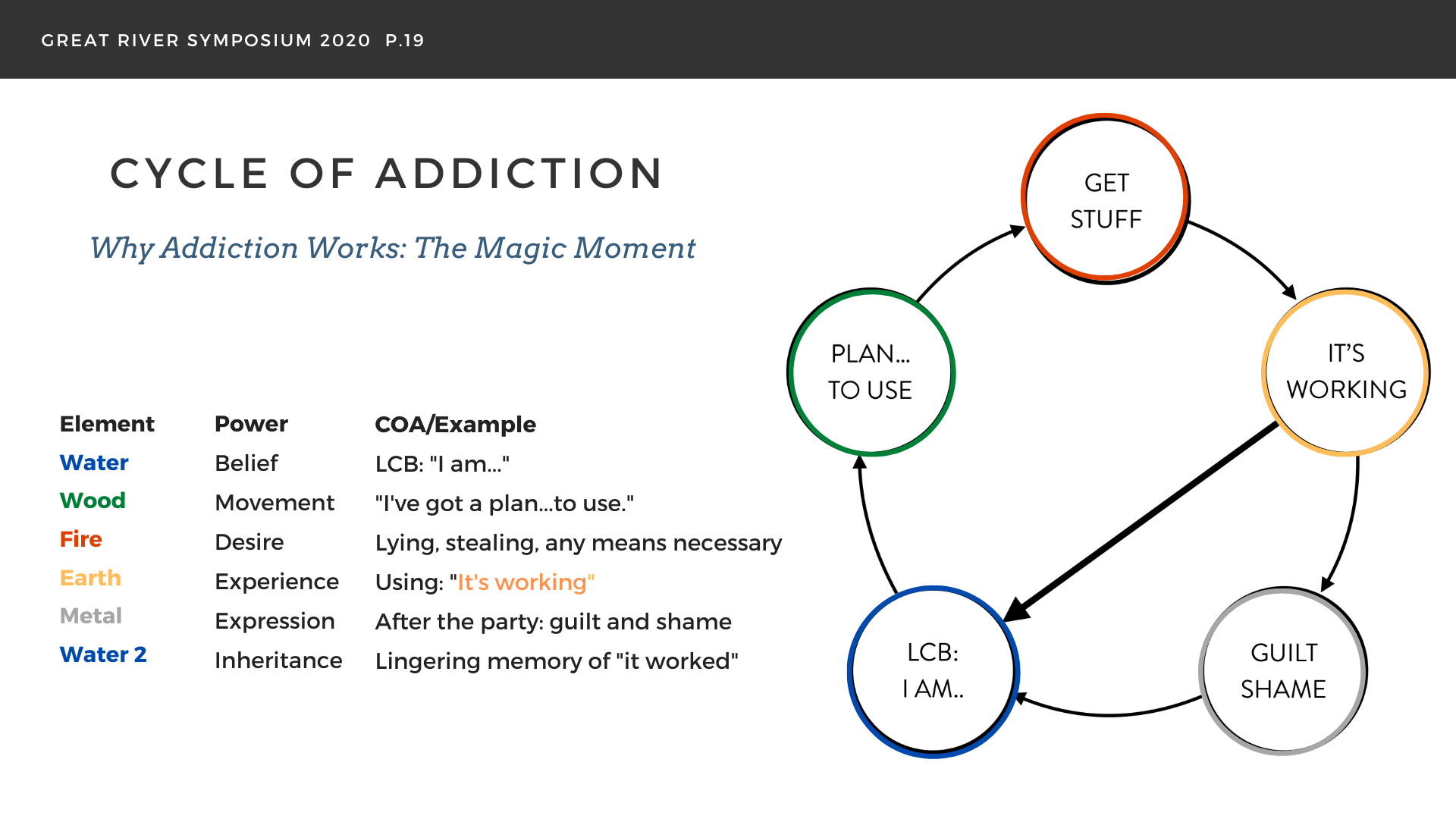
Done repeatedly, usually in the same way each time and always culminating in the Magic Moment before indulging, they acquire power. Not power that serves us or that works in our favor. Power that strengthens our communion with unhelpful patterns, dangerous spirits, and the hold they have over us and our lives.
For Example…
Cocaine: I chop, you choose.
- In this ritual, one member of the cocaine party is designated as “the one who chops.” They’re in charge of mashing larger rocks of cocaine into powder and dividing that powder into however many lines are needed to allow everyone to partake.
- Everyone else gets to choose their line first, before the one who chops. The chopper thus has a vested interest in making sure all the lines are the same (otherwise, they’ll be getting the short end of the stick).
- This creates a “ritual of chopping” around creating identical lines.
Heroin: My favorite…
- Ask a heroin user about their favorites—I guarantee you, they’ve got them. From the accoutrements of the needle, arm tie, spoon, and lighter…to their scheduled rotation of entry veins and mental calendar of when and how they are used.
Alcohol: Pre-game warmups
- With alcohol, the rituals vary but all feed the same ends and the same spirits.
- For some, it’s a Sunday afternoon sports bar promoting games on every screen and specials on pitchers of beer. Or happy hour and the mariachi band at a Mexican restaurant. Or the ambience, sophistication, and “class” involved with the swirling and smelling of wine. Or opening a bottle of wine while making dinner.
- If alcohol’s “your thing,” think about it. What rituals did or do you engage in before taking that first sip?
Gambling: “Good evening. Your usual table, Mr. Smith?”
- The ritual of casino life offers a perfect example here. Once inside, external distractions disappear along with our sense of time.
- There are no windows. There is no “last call.” Selective sensory deprivation pushes gamblers to focus on one thing and one thing only: the dinging of the machines, the voices of the croupiers from the blackjack table and roulette wheel, and the game in front of them.
- Ritual is everywhere. Addiction always wins.
These and all other addictions come with their own brand of powerful, predictable rituals. While the details vary, the purpose and effect is the same:
- They eliminate outside distraction, focus our attention and actions, and bring clarity to the inevitable next step.
- They herald and intensify the moment when we commune with our drug of choice (plus its nasty spirits).
Changing the Ritual, Communing with Different Spirits
So where to from here? How do we step out of those rituals and create ones that lead us to connect with kind spirits and healthier, more whole ways of being?
First, if you’re still in active addiction, take note of your pre-game line-up.
- Notice your surrounds and the steps you take.
- See what happens when you bring the medicine of awareness into your usual rituals.
- See what happens when you interrupt the process. (Spoiler: The very act of awareness already changes things.)
Second, what new rituals and new spirits might support your life in recovery?
- No need to make this esoteric—keep it simple and remember what you love or always wanted to try or learn.
- What new, healthy activities could you weave into recovery? Pick one. Start there.
- It could be a religious or spiritual practice but doesn’t have to be. It could be an exercise class, a cooking class (or cooking at home, perhaps from your grandma’s recipe), a martial art with a group or in private, walks in Nature, etc. There are endless possibilities and no wrong ways to go about it so long as it’s supportive rather than feeding an addictive, harmful cycle.
Third, while preparing for and partaking in your new ritual and experiencing a new, more helpful communion:
- Make a list of your next steps related to this ritual, writing them out from A to Z.
- As you carry out those steps, bring awareness to what you’re doing.
- Make a clear intention to connect and a clear intention that this is medicine for your addiction.
- Make a clear intention as well to be open-hearted and open-minded with anyone you connect with in the process.
- And, make a clear boundary to keep out those who would detract from your new ritual and/or pull you back towards the unhelpful rituals of the past.
- Hold all of this in your heart and mind as you go through the steps of your new ritual.
- When finished, thank all you’ve seen and done and all who’ve supported you in the process.
- Release the helping spirits with acknowledgement and gratitude.
- Leave a gift—such as by saying a kind word or paying it forward.
When viewed through a shamanic lens, we are constantly performing rituals that connect us to spirit.
Through the above practice, we make the intentions that go into those rituals conscious. We source them from a place of healthy awareness instead of unconscious, reactive, and addictive patterns.
Now You (or Your Loved Ones)
If you, or someone you know, is struggling with addiction and communing with all manner of unhelpful, malevolent substances and spirits, I’m living proof that there is a way out. There is a way to regain what was lost and find what was originally promised.
NOT by doing the old, addictive rituals again and again. NOT by engaging in other rituals that may be meaningful for some but feel empty for us.
Rather, by following the above steps as a starting place. And, from there, communing with spirits, experiences, and ways of being that support us. Ones that help us truly connect and ones that help us heal.
If you want to support others on this path, consider gifting them a subscription to The Sober Shaman:
And if they or you are ready for more, head here for a Free Preview of The Sober Shaman’s Path of Recovery.
As always, if you have questions or just want to share, please do in the comments. Also feel free to email me directly at Randy@AlchemistRecovery.com.
With All Good Medicine,
Randal
Copywriting and editing by my wife and partner, Dr. , who shares raw, unfiltered writing about sobriety and soulful living at .